 it
it  en
en
News and Events
FOR TECHNICAL REASONS, THE UPDATING OF THIS SITE IS TEMPORARILY SUSPENDED. DURING THE INTERRUPTION AND UNTIL THE RESTORATION OF NORMAL ACTIVITIES, THE PERIODIC UPDATES WILL BE PROVIDED ON THE FACEBOOK GROUP BIRDSTRIKE.IT
The Pakistani airline has suffered 66 bird strikes since the beginning of the year and consequently suffered significant financial damage. The airline spokesman therefore reiterated the request for the adoption of appropriate prevention measures in domestic airports.
The proposal to place a landfill near Dunedin airport in New Zealand is giving rise to justified concerns. The plant would rise at a distance of 6.5 km. from the airport, well within the buffer zone of 13 km. required by international standards. Extraordinary measures to manage and mitigate the risk caused in this case by seagulls are being studied.
Since the beginning of the year, Sacramento airport has recorded 74 bird strikes. Although they are still a long way from the unpleasant impact record (190) of 2015, the issue is of serious concern. Although the airport is located exactly along one of the routes followed by migratory birds, statistics show that most impacts involve species commonly found in the Sacramento region. The article also contains interesting statistical data.
The article describes the initiatives carried out by the Taiwan airport to reduce the risk of bird strikes.
The project currently under evaluation provides for the use of pigs in the fields surrounding the airport in order to eliminate the presence of crop residues after harvesting, in particular beets. These vegetables are particularly appreciated by the geese that infest those areas and constitute a potential danger for aircraft. The article cites as proof of an event occured two years ago to a KLM B747 but an even more serious event occurred in 2010 to a Royal Air Maroc B737 while taking off.
Just as in Pakistan (see above), Nigerian airlines are strongly protesting against the increase in costs due to the continuous maintenance of aircraft that have suffered impacts with wildlife. The situation is even more serious when one considers that airlines also have difficulty in finding the foreign exchange needed to purchase spare parts. Moreover there are the lost earnings caused by the grounding of aircraft being repaired.
- 1 October 2021 – Philadelphia (PA)
American Airlines A321, in the initial climb the left hand engine ingested a bird; the crew decided to return and landed back about 25 minutes after departure. A runway inspection found bird debris on the runway. - 2 October 2021 – Atlantic City
Spirit A320, rejected take off at a speed of 90 kts following the ingestion of a large bird in the right engine. A few seconds after the aircraft had stopped on the runway, the TWR advised the crew that fire was coming out from the lower part of the right engine. At this point the crew ordered the evacuation of the plane during which three passengers and an off-duty employee received minor injuries. An initial damage analysis revealed that an entire fan blade had fractured at its root and separated. In the links below one can find an extensive review of photos and videos of the event.
http://www.avherald.com/h?article=4ee2677c&opt=0
https://jalopnik.com/spirit-airlines-plane-bursts-into-flames-after-ingestin-1847796488
https://6abc.com/new-video-shows-moment-spirit-passengers-had-to-evacuate-plane/11077421/ - 3 October 2021 – Islamabad
Serene Air A330, on final approach a bird impacted the aircraft damaging the right hand main gear and requiring the replacement of parts. - 5 October 2021 – Lahore
Turkish Airlines B777, suffered a bird strike on takeoff and landed back. The aircraft suffered substantial damage to its wings.
https://www.geo.tv/latest/374078-foreign-airlines-plane-survives-bird-strike-lands-safely-at-lahore-airport - 10 October 2021 – Karachi
PIA A320, bird strike on approach.
https://nation.com.pk/10-Oct-2021/karachi-bound-pia-aircraft-escapes-accident - 10 October 2021 – Corfu (Greece)
Eurowings A320, during the initial climb the crew reported a bird strike into the right hand engine and decided to land back. - 13 October 2021 – Manchester
Ryanair B737, bird strike during the initial climb; the crew decided to divert to Liverpool where the aircraft landed about 55 minutes after departure.
https://dnyuz.com/2021/10/13/bird-strike-forces-unhealthy-sounding-plane-full-of-passengers-to-make-emergency-landing/ - 13 October 2021 – Boston (MA)
Republic ERJ175, the aircraft sustained a bird strike at take off that prevented operation of the slats and flaps. Minor damage.
https://www.foxbangor.com/national-news/american-airlines-plane-lands-without-incident-after-reported-bird-strike/ - 14 October 2021 – Orlando (FL)
Spirit A321, bird strike on final damaging the nose cone. - 14 October 2021 – Aspen (CO)
Skywest CRJ700, after take off the crew reported they had received a bird strike onto the windshield with no damage. Later they reported the windshield had cracked and decided to divert to Grand Junction (CO) where they landed about 75 minutes after departure.
A runway inspection found the remains of a small bird on the runway. - 15 October 2021 - Sao Paulo (Guarulhos)
Brazil, ITA Transportes Aereos (Itapemirim) A320, in the initial climb the right hand engine (V2527) ingested at least one bird prompting the crew to return about 15 minutes after departure. - 17 October 2021 – Salt Lake City (UT)
Delta A220, bird strike on approach; nose damaged. - 17 October 2021 - Houston (TX)
Commutair ERJ145, bird strike on approach with a large bird; wing leading edge damaged. - 21 October 2021 – Rome
Lufthansa A320, bird strike on landing; return flight cancelled. - 21 October 2021 – Fort Lauderdale (FL)
Spirit Airlines A320, on final struck a bird at about 1500 ft. and received a dent in the nose cone. - 21 October 2021 – Madison (WI)
United B737, on approach received a bird strike that damaged the windshield. - 23 October 2021 – Iraklion (Greece)
Lufthansa A321, bird strike on approach; nose damaged.
https://www.aerotime.aero/29268-lufthansa-airbus-a321-suffers-nose-damage-after-bird-strike
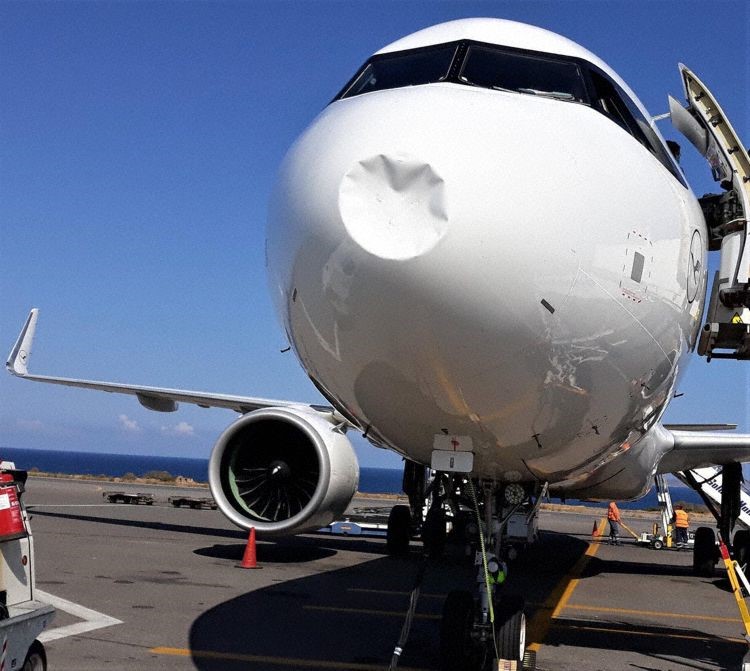
(The dent in the nose cone; photo by Babis Almpantakis Taken from Avherald.com)
- 27 October 2021 – Madrid
Iberia A350, on final at about 1000 ft. struck a vulture that remained trapped in the nose cone.
https://www.independent.co.uk/travel/news-and-advice/vulture-bird-strike-plane-madrid-b1946849.html

(The vulture trapped in the nose cone; photo Controladores Aereos taken from AvHerald.com)
- 27 October 2021 – Orlando (FL)
American B737, on approach struck a bird and damaged right leading edge of the right engine. - 28 October 2021 – Bucharest
TAROM A318, in the initial climb a bird first impacted the nose gear and subsequently was ingested by the right hand engine causing sparks. The crew landed back immediately. A runway inspection recovered a bird carcass from the runway. - 29 October 2021 – Oakland (CA)
Southwest B737M, struck a bird on takeofff and continued the flight to destination. A post flight inspection revealed substantial damage to an engine. - 31 October 2021 – Newark (NJ)
United A320, bird strike at about 8000 ft. that caused damage to the nose cone. The crew about 20 minutes after departure. - 1 November 2021 – Pskov (Russia)
Azimuth SU95, collided with a roe deer and received damage to the right hand wing and engine.
https://www.youtube.com/watch?v=udK8Atlb7Z0 - 2 November 2021 – Genoa
Ryanair B737, suffered a bird strike on landing. The aircraft, was grounded and a replacement aircraft carried out the return leg. - 2 November 2021 – Nepalgunj (Nepal)
SITA Do228, was accelerating for takeoff when the aircraft collided with 3 wild boars prompting the crew to reject takeoff. The aircraft came to a stop with the nose gear partially collapsed/bent backwards and damage to the underside of the fuselage.
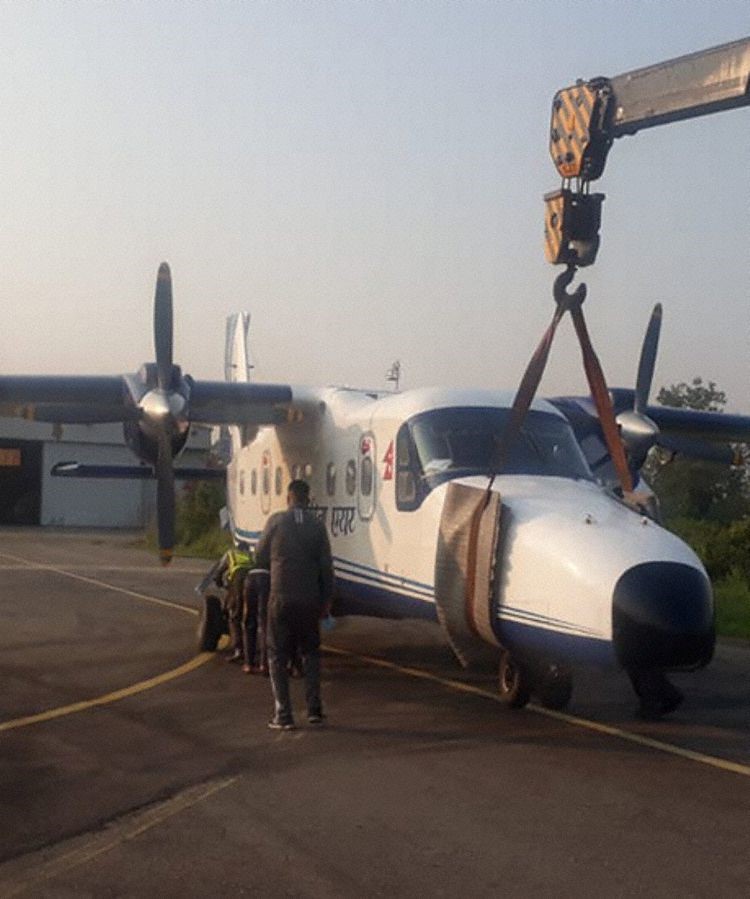
(The recovery of the aircraft; photo taken form Avherald)
- 3 November 2021 – between Greensboro (NC) and New York (La Guardia)
Endeavor CRJ900, a post flight inspection revealed damage to radome as result of a bird strike. - 3 November 2021 – Chicago (O’Hare)
Gojet CRJ700 on short final a bird hit the left engine causing damage. - 7 November 2021 – Seattle (WA)
Skywest ERJ175, in the initial climb the right engine ingested a bird; the crew landed back 35’ after take off. - 8 November 2021 – Barcelona
Vueling A320, bird strike in the initial climb; the crew landed back 35’ after take off.
https://www.preferente.com/noticias-de-transportes/noticias-de-aerolineas/un-avion-choca-contra-un-pajaro-y-regresa-al-aeropuerto-de-barcelona-313568.html - 8 November 2021 – Orlando (FL)
Delta B757, ejected takeoff at high speed (about 100 knots over ground) due to a bird strike into the right engine. - 8 November 2021 – Orlando (FL)
Allegiant A320, in the initial climb the aircraft flew through a flock of birds and received a number of bird strikes; the crew landed back about 12 minutes after departure. Damage was found to the blades of the right engine. - 8 November 2021 – Benin Airport
Air Peace B737, rejected take off due to a bird strike.
https://tribuneonlineng.com/benin-abuja-air-peace-flight-aborted-over-bird-strike - 9 November 2021 – Newark (NJ)
Jetblue A320, bird strike on final; after landing found a small dent in a static wick. - 10 November 2021 – Ust-Kut (Russia)
Angara Airline An24, on approach performed a go-around due to the presence of a pack of dogs on the runway.
https://t.me/aviaincident/11711 - 15 November 2021 – Sacramento (CA)
Aeromexico B737, bird strike in the initial climb; the crew decided to burn off fuel and return for landing about 100 minutes after departure.
https://sacramento.cbslocal.com/video/6159739-bird-strike-scare-at-sacramento-international-airport/ - 15 November 2021 – Dallas (TX)
American A321, bird strike on final; minor damage. - 16 November 2021 – Porto Alegre
LATAM Brasil A321, at about the rotation the left engine ingested a bird and emitted several bangs and streaks of flames as well as strong vibrations. The crew decide to return and landed back 25 minutes after departure. - 19 November 2021 – Olbia (Italy)
Volotea A320, rejected take-off at high speed (154 kts) due to a bird ingestion in one engine. Several fan blades damaged.
https://www.olbianova.it/volotea-paura-a-bordo-per-lo-scontro-tra-un-aereo-e-un-gabbiano-i-passeggeri-abbiamo-sfiorato-la-tragedia/?fbclid=IwAR3LpRQtVUQh0dK-1Of9JcjyFsKv5mt61lh4Ld1dAxD7VIr_Qm0E-EZ_0Hw

(The damaged fan blades; photo taken from Avherald.com)
- 22 November 2021 – Owerri (Nigeria)
Air Peace B737, during the initial climb an engine ingested a bird and emitted bangs; the crew landed back.
https://dailypost.ng/2021/11/22/birds-strike-lagos-bound-air-peace-flight/ - 23 November 2021 – Salt Lake City (UT)
Skywest CRJ200, in the initial climb flew through a flock of birds receiving several impacts. The crew continued the flight to destination where landed about 45 minutes after departure. An inspection revealed a dent in the right wing. - 23 November 2021 – Trenton (NJ)
Frontier Airlines A320, on approach the aircraft flew through birds and received a number of bird impacts. A post flight inspection revealed a hole in the fuselage. - 24 November 2021 – Bologna
Malta Air B737, on final approach the aircraft flew through a flock of herons, which impacted nose, windshield, both wings. A number of herons were ingested by the right hand engine which subsequently suffered compressor stalls until touch down. Post flight examination revealed evidence the left hand engine had also ingested a number of birds.
https://www.youtube.com/watch?v=LbkBJK45QQ8
https://www.the-sun.com/news/4152543/ryanair-plane-covered-bird-carcasses/ - 24 November 2021 – Moscow (Sheremetyevo)
Aeroflot B777, was accelerating for takeoff when the aircraft collided with a number of pigeons. In the absence of abnormal indications the crew continued takeoff and continued to destination (Beijing, 6.5 hours). About 8-10 pigeon carcasses were recovered from the runway. A post flight inspection revealed damage to fan blades 3 and 6 of the left hand engine, to the air intakes and cowlings of both engines, inner flaps right wing and right main landing gear strut. A detailed inspection found structural damage to the Outlet Guide Vanes. - 28 November 2021 – Madrid
British Airways A380, on approach a bird impacted the aircraft's inboard left engine's (n. 2) inlet and was ingested by the engine. The aircraft was unable to depart for the return flight that was cancelled. - 28 November 2021 – Sofia
Lufthansa A320, rejectd take off at high speed due to a multiple bird strike; flight cancelled. - 30 November 2021 – Cox Bazar (Bangladesh)
Biman B737, during the take off run just after becoming airborne hit two cows on the runway. Either a wing of the aircraft or its main gear struck the cows.The crew continued the flight to Dhaka where the aircraft performed a low approach and then landed. - 30 November 2021 – New York (La Guardia)
Republic ERJ175, on final approach the aircraft went around from low height (less than 300 feet AGL) reporting they had flown through a flock of geese and may have hit one. The aircraft then landed about 15 minutes after the go around. Minor damage to an engine. - 2 December 2021 – Islamabad
Serene Air A330, on approach a bird impacted the landing gear of the aircraft.
https://www.samaa.tv/news/2021/12/islamabad-bound-flight-survives-bird-strike/ - 2 December 2021 – Salt Lake City (UT)
Delta A220, multiple bird strike on approach. - 7 December 2021 – Des Moines (IA)
American A319, in the initial climb the aircraft collided with a flock of birds suffering damage to the left engine, right wing and bottom of fuselage. Immadiate landing back about 10 minutes after departure. - 12 December 2021 – Parma
Malta Air B737, rejected take off at low speed (40 kts) due to a bird ingestion into one engine.
https://www.unionesarda.it/news-sardegna/cagliari/fiammata-durante-il-decollo-paura-sul-volo-parma-cagliari-uqll8xro - 12 December 2021 – Fort Lauderdale (FL)
Jetblue Airways A320, on approach a bird impacted the leading edge of an engine cowling causing damage. - 14 December 2021 – Delhi
Vistara A320, in the initial climb suffered a bird strike; as the instrument panels were showing normal readings the crew decided to continue the flight to destination (about 60’) finding out after landing that they could not perform the return flight and that the aircraft needed to be replaced.
https://timesofindia.indiatimes.com/city/lucknow/flight-with-148-passengers-suffers-bird-strike-in-delhi-air-aircraft-grounded-in-lucknow/articleshow/88284266.cms - 18 December 2021 - Zurich
Edelweiss A320, rejected take off at high speed (96 kts), due to the ingestion of a bird into the right engine. - 26 December 2021 – Santa Cruz (Bolivia)
Boliviana de Aviacion B737, rejected take off due to the ingestion of a bird into an engine.
Air traffic control plays a fundamental role in accident prevention within a generally clear and detailed regulatory framework. However, some air navigation service providers have been involved in legal proceedings following birdstrike events; at least in one case the Control Tower has been sentenced by a Court to refund part of the damage following an assignment of liability.
